A great discussion about Lord Byron’s Life

Here is an informative podcast about Lord Byron’s Childe Harold’s Pilgrimage: BBC In Our Time, January 6, 2011 Though I found the host’s frequent interruptions annoying, I’m sure I’ll revisit this program.

Here is a summary of nearly all the topics discussed with his guests:

  • Byron’s aristocratic background and his grandfather, an admiral named “Foul Weather Jack.”
    Engraving of Byron's father, Captain John

    Engraving of Byron’s father, Captain John “Mad Jack” Byron, date unknown (Photo credit: Wikipedia)

  • His father, “Mad Jack,” an army captain and drunken profligate. Jack seduced and married an aristocratic heiress named Amelia. After she died, he was in debt and on the run from creditors. He remarried “a rather plain plump Scottish girl named Catherine” for her money. Three years later, Mad Jack died (at 35) and she was bankrupt. (Catherine was Byron’s mother; Amelia was the mother of Byron’s half-sister Augusta, with whom he would have a scandalously incestuous relationship.)
  • Byron’s club foot.
  • Sexual abuse by his Calvinist nurse.
  • The rejection of one of his early works, Hours of Idleness
  • His retaliatory assault on poets and critics in English Bards and Scotch Reviewers. “It was English Bards that brought him to real public prominence…” a guest said, and not Childe Harold’s Pilgrimage, of which Byron famously said “I awoke to find myself famous.”
  • His capacity for hate / holding grudges
  • 1809 – Byron’s grand tour – speculation on why he left to England: “This remains a mystery to some degree… it may have been because of his homosexual tendencies, which he felt he could only indulge in the East…” along with a love of Greek culture, etc.
  • The meaning of “childe” and why he started writing the poem.
  • The influence of Edmund Spenser (the poem is written in Spenserian stanzas).
  • The innovative style of the poem: “There were lots and lots of travel poems in the period… but what’s unique about CHP is that it’s simultaneously a travelogue, a political poem… and a very personal poem with all sorts of veiled references to personal scandal, and that’s what’s new”
  • The similarities between — and the merging of — the fictional Harold and the real Byron.
  • The break up of his marriage
  • How Byron was the first to write about “The shame of war, the disgrace of war — this is something entirely new in English poetry.”
  • Byron’s descriptions of bull-fighting.
  • On Greece becoming a “sad relic of departed worth”
  • 1812 – Childe Harold first published by Murray
  • Byron was one the first celebrities, before “being famous” was commonplace
  • 1816 – Byron left Britain for good following the exposure of his affair with his half-sister, along with rumors of attempted sodomy with his wife, etc.
  • His dangerously liberal politics.
    Frontispiece to a c. 1825 edition of Childe Ha...

    Frontispiece to a c. 1825 edition of Childe Harold’s Pilgrimage (Photo credit: Wikipedia)

  • His description of the Battle of Waterloo (Canto III) and his feelings about Napoleon.
  • What exactly is a “Byronic hero”?
  • What Byron doesn’t like about Wordsworth: his isolation from humanity
  • His continued status as a political hero in Greece and elsewhere. “There was a cult of Byron in every European country, except for Portugal.” (They never forgave him for insulting their country.)
  • Byron’s influence on other artists, including Bram Stoker: “Every vampire you encounter is based on Lord Byron”

Unpoetic Subjects

I listened to the wind

and to the speaking leaves

And learned not a thing

but to pause and to breathe

Dear reader, thank you for your continued interest in my blog. I was in Zilker Park (Austin, Texas), taking a break from writing a more ambitious poem about weedwackers when I wrote those lines.

The prospect of writing poems about seemingly unpoetic subjects delights me immensely. Weedwackers and leaf-blowers would surely shatter the noonday reveries of Romantic poets, yet they fill me with nostalgia. Their hypnotic hum in the distance seems like the sleepy sound of summer itself, inseparable from the languorous, Floridian days of my youth. Weedwackers are “mechanical cicadas, biting not to eat” wielded by “invisible men, to keep teeming Nature neat.” (I’m still working on it.)

Poets should embrace the world in its entirety. You don’t need to cultivate a poetic mood to write poetry, you need to cultivate poetic eyesight.

When I see blackened blobs of dried gum in a parking lot, they inspire me to write. The Tao Te Ching has taught me that the world should not be divided into beautiful and ugly, or other dualisms. (There is only the Tao, the Way, the unity of all things – whatever that means.)  Our minds, craving categorization and simplicity, fall prey to false opposites all the time: good and evil, us and them, right and wrong, etc.

Just as I occasionally find unlikely beauty in “ugliness,” I sometimes see ugliness in what traditionally is regarded as beautiful. For example, Nature inspires us with its beauty, but often I reflect on how brutal it is: a cycle of killing, eating, evading, surviving and mating. It’s as ruthless as capitalism. Nature relaxes you, but Nature is hardly relaxed. Nature is relentless struggle and death.

Submitting everything we see to convenient labels, to approval or rejection, to celebration or complaint, is easy but unsubtle, and blunts the mind to true understanding. For example: Advertising is ugly. And flowers are beautiful, right? Yet consider that flowers merely serve as billboards for bees and other pollinators. Their beauty, to our eyes, is an accidental development. Nature has employed advertising for eons.

And beauty of course, is subjective and species specific. There is nothing more alluringly beautiful to the fly than the tantalizing scent of putrefying flesh.

Lord Byron in Portugal – continued

The story so far: having escaped death at the hands of assassins, Lord Byron continues his sight-seeing tour of Portugal, describing the sights as seen by his fictional character Childe Harold.

XXII.

On sloping mounds, or in the vale beneath,
Are domes where whilom kings did make repair;
But now the wild flowers round them only breathe:
Yet ruined splendour still is lingering there.
And yonder towers the prince’s palace fair:
There thou, too, Vathek! England’s wealthiest son,
Once formed thy Paradise, as not aware
When wanton Wealth her mightiest deeds hath done,
Meek Peace voluptuous lures was ever wont to shun.

whilom = formerly. “England’s wealthiest son” is a reference to William Beckford, author of Vathek, considered a classic gothic novel. I have a nicely illustrated copy of it, and confess I have yet to read it, though it’s not lengthy.

English: The hall of Fonthill Abbey in Wiltshi...

English: The hall of Fonthill Abbey in Wiltshire, England (Photo credit: Wikipedia)

A wealthy eccentric, the life of Beckford is worth mentioning. At five he received piano lessons from Mozart, who was nine years old at the time. His father, twice Lord Mayor of London, bequeathed him, his only son, a vast fortune derived from Jamaican sugar plantations powered by slave labor. Beckford blew most of his fortune on collecting art and on building Fonthill Abbey, a gigantic gothic construction with a central tower that ended up collapsing twice.

When his sexual involvement with a young boy was exposed (Beckford was 18 and the boy 10 when they first met), he chose self-exile, fleeing to the Continent with his wife.

Fonthill Abbey. Built 1795 - 1807 by James Wya...

Fonthill Abbey. Built 1795 – 1807 by James Wyatt for William Beckford, the author of the gothic fantasy novel Vathek. (Photo credit: Wikipedia)

XXIII.

Here didst thou dwell, here schemes of pleasure plan.
Beneath yon mountain’s ever beauteous brow;
But now, as if a thing unblest by man,
Thy fairy dwelling is as lone as thou!
Here giant weeds a passage scarce allow
To halls deserted, portals gaping wide;
Fresh lessons to the thinking bosom, how
Vain are the pleasaunces on earth supplied;
Swept into wrecks anon by Time’s ungentle tide.

Apparently, a pleasaunce, aside from meaning enjoyment, is also “the region of a garden with the sole purpose of giving pleasure to the senses, but not offering fruit or sustenance” (an obsolete definition from allwords.com). A pleasaunce, full of pretty but useless, fruitless plants, is a fine metaphor for empty pleasures. Take care, dear reader, lest you end up ruined with no more than a garden full of giant weeds!

Vain are the pleasaunces on earth supplied; Swept into wrecks anon by Time’s ungentle tide.

Lord Byron in Portugal

The Story so far… Childe Harold has fled his native land and the empty pleasures of his hall, because there’s nothing and no one to keep him at home. He is about to arrive in Portugal. (For earlier portions, see the Childe Harold Project)

XIV.

On, on the vessel flies, the land is gone,
And winds are rude in Biscay’s sleepless bay.
Four days are sped, but with the fifth, anon,
New shores descried make every bosom gay;
And Cintra’s mountain greets them on their way,
And Tagus dashing onward to the deep,
His fabled golden tribute bent to pay;
And soon on board the Lusian pilots leap,
And steer ‘twixt fertile shores where yet few rustics reap.

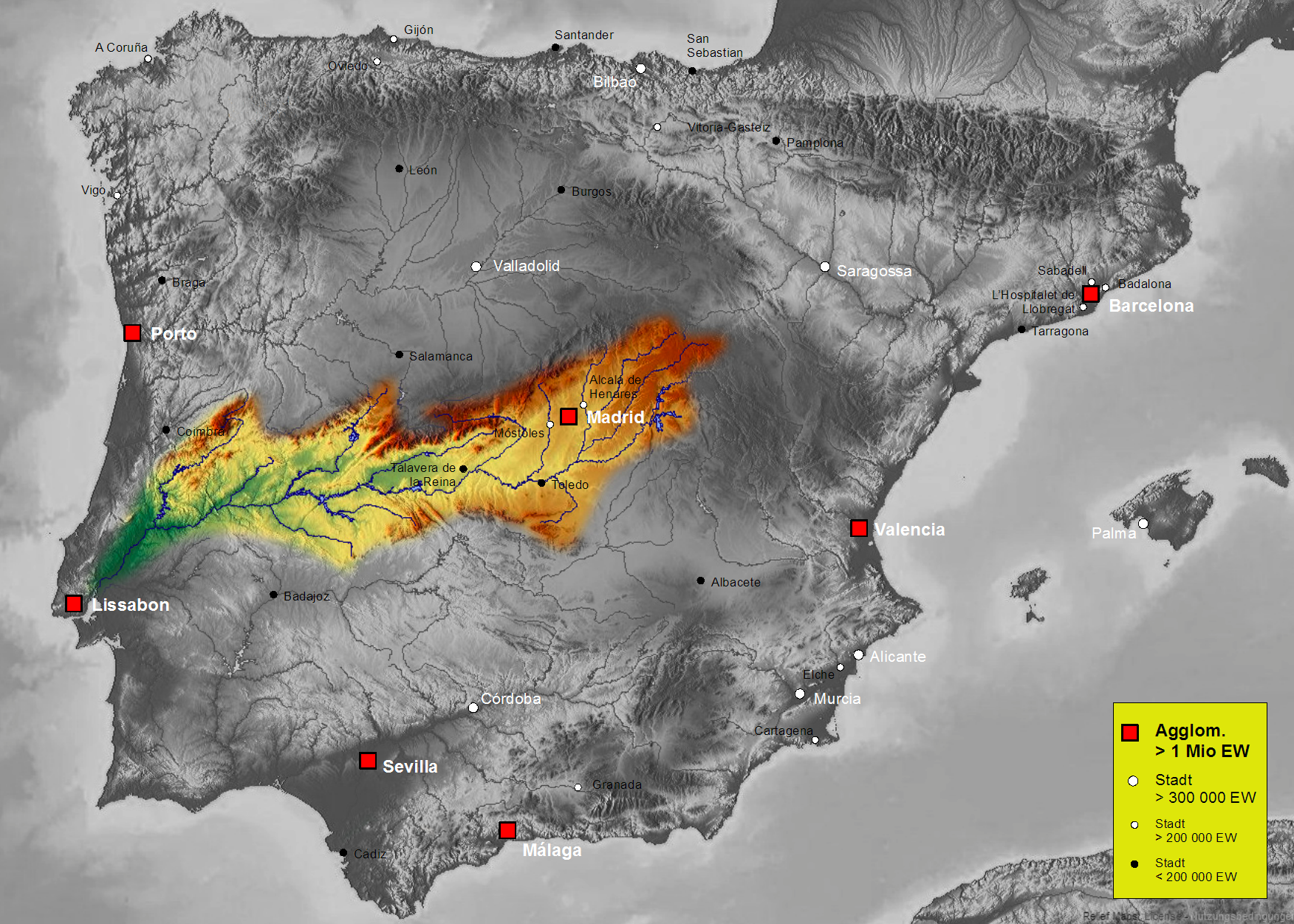
Bay of Biscay = see image

English: This is a map showing the location of...

Cintra = city northwest of Lisbon. Sintra seems to be the modern spelling.

Tagus = longest river on the Iberian Peninsula. (Tajo in Spanish, Tejo in Portuguese; Tagus is Latin.)

Lusian = Portuguese

XV.

Oh, Christ! it is a goodly sight to see
What Heaven hath done for this delicious land!
What fruits of fragrance blush on every tree!
What goodly prospects o’er the hills expand!
But man would mar them with an impious hand:
And when the Almighty lifts his fiercest scourge
‘Gainst those who most transgress his high command,
With treble vengeance will his hot shafts urge
Gaul’s locust host, and earth from fellest foemen purge.

“Gaul’s locust host” refers to the French. Apparently, Byron sees war with the French as a form of divine punishment on the Portuguese for their destruction of the landscape. Lacking specifics, I’ll just read on.

Fellest = According to Merriam-Webster, fell can mean: a : fierce, cruel, terrible; b : sinister, malevolent <a fell purpose>; c : very destructive : deadly <a fell disease>

XVI.

What beauties doth Lisboa first unfold!
Her image floating on that noble tide,
Which poets vainly pave with sands of gold,
But now whereon a thousand keels did ride
Of mighty strength, since Albion was allied,
And to the Lusians did her aid afford
A nation swoll’n with ignorance and pride,
Who lick, yet loathe, the hand that waves the sword.
To save them from the wrath of Gaul’s unsparing lord.

Lisboa or Lisbon, is the capital of Portugal

“Which poets vainly pave with sands of gold” – this line, combined with those from Stanza XIV:  “And Tagus dashing onward to the deep, His fabled golden tribute bent to pay” seem to have a story behind them; I’m guessing false or exaggerated tales of gold.

England (Albion) came to aid the Portuguese (Lusians), with “a thousand” ships (is he being literal here? – that’s quite a fleet). Byron paints quite an unflattering image of the nation of Portugal.

Gaul’s unsparing lord = Napoleon.

XVII.

But whoso entereth within this town,
That, sheening far, celestial seems to be,
Disconsolate will wander up and down,
Mid many things unsightly to strange e’e;
For hut and palace show like filthily;
The dingy denizens are reared in dirt;
No personage of high or mean degree
Doth care for cleanness of surtout or shirt,
Though shent with Egypt’s plague, unkempt, unwashed, unhurt.

sheen = to be bright, show a sheen (to be bright or shining)

surtout =a man’s long, close-fitting overcoat. pronunciation

shent = destroyed / also “to put shame to” or reprove

XVIII.

Poor, paltry slaves! yet born midst noblest scenes—
Why, Nature, waste thy wonders on such men?
Lo! Cintra’s glorious Eden intervenes
In variegated maze of mount and glen.
Ah me! what hand can pencil guide, or pen,
To follow half on which the eye dilates
Through views more dazzling unto mortal ken
Than those whereof such things the bard relates,
Who to the awe-struck world unlocked Elysium’s gates?

The scene is more dazzling than anything described by … earlier I thought Shakespeare, but W. Hiley, editor of an 1877 edition I found on Google Books, says Dante.

ken = another one of those nice old words, meaning the range of vision; sight or view; the range of perception, knowledge or understanding.

Elysium = the Greek version of paradise, a place often mentioned in old poetry.

XIX.

The horrid crags, by toppling convent crowned,
The cork-trees hoar that clothe the shaggy steep,
The mountain moss by scorching skies imbrowned,
The sunken glen, whose sunless shrubs must weep,
The tender azure of the unruffled deep,
The orange tints that gild the greenest bough,
The torrents that from cliff to valley leap,
The vine on high, the willow branch below,
Mixed in one mighty scene, with varied beauty glow.

The word “toppling” caught my e’e – it’s an interesting word choice. Perhaps the crags seem toppled or overthrown by the convent; it also conveys the feeling of resting “atop” the crags. Also, you get a nice assonance with “toppling” and “convent.” That’s my thought, anyway.

hoar = a word you see oft in Romantic poetry. Hoar, hoary  – anything that’s white or gray, or ancient can be described with this word. It’s also a synonym for frost / sometimes I’ve seen “hoar-frost.” It’s unfortunate that this fine old-fashioned word and “whore” are homophones.

Reading poetry aloud is essential for appreciating the repetition of certain sounds: “horrid”, “hoar,”   “scorching,” “torrents”; “sunken”  and “sunless” and “unruffled”; “glen” and “tender.”

azure = blue

XX.

Then slowly climb the many-winding way,
And frequent turn to linger as you go,
From loftier rocks new loveliness survey,
And rest ye at ‘Our Lady’s House of Woe;’
Where frugal monks their little relics show,
And sundry legends to the stranger tell:
Here impious men have punished been; and lo,
Deep in yon cave Honorius long did dwell,
In hope to merit Heaven by making earth a Hell.

Two things worth mentioning here – Byron’s translation error and Honorius.

Nossa Senora de Peña or “our Lady’s house of woe” should be translated as “our lady of the rock”  (rock is peña; pena is Portuguese for punishment). Byron addresses the error in his notes to Cantos I-II.
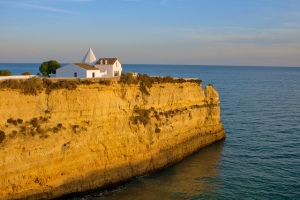
Our Lady of the Rock

Our Lady of the Rock

I looked up Honorius in Wikipedia; he lived in the Convento de Santa Cruz da Serra da Sintra (Convent of the Holy Cross of the Sintra Mountains), lived to be 100, and spent the last thirty years of his life living in a small hole, which still exists today. Wish I had an image of it! Robert Southey, a poet and contemporary of Byron’s wrote this:

Inscription for the Cell of Honorius, at the Cork Convent, near Cintra
Robert Southey (1774–1843)
HERE, caverned like a beast, Honorius passed,
In self-affliction, solitude, and prayer,
Long years of penance. He had rooted out
All human feelings from his heart, and fled
With fear and loathing from all human joys.
Not thus in making known his will divine
Hath Christ enjoined. To aid the fatherless,
Comfort the sick, and be the poor man’s friend,
And in the wounded heart pour gospel-balm,—
These are the injunctions of his holy law,
Which whoso keeps shall have a joy on earth,
Calm, constant, still increasing, preluding
The eternal bliss of heaven. Yet mock not thou,
Stranger, the anchorite’s mistaken zeal!
He painfully his painful duties kept,
Sincere, though erring. Stranger! do thou keep
Thy better and thine easier rule as well.

XXI.

And here and there, as up the crags you spring,
Mark many rude-carved crosses near the path;
Yet deem not these devotion’s offering—
These are memorials frail of murderous wrath;
For wheresoe’er the shrieking victim hath
Poured forth his blood beneath the assassin’s knife,
Some hand erects a cross of mouldering lath;
And grove and glen with thousand such are rife
Throughout this purple land, where law secures not life!

So – not only are the Portuguese (of all social classes) dirty and dingy in appearance, but apparently the murder rate is out of control. Byron is a young tourist, already guilty of a translation error – perhaps not every cross denotes a murder.

Here is what he says in his notes to Cantos I-II:

“It is a well-known fact, that in the year 1809 the assassinations in the streets of Lisbon and its vicinity were not confined by the Portuguese to their countrymen; but that Englishmen were daily butchered: and so far from redress being obtained, we were requested not to interfere if we perceived any compatriot defending himself against his allies. I was once stopped in the way to the theatre at eight o’clock in the evening, when the streets were not more empty than they generally are at that hour, opposite to an open shop, and in a carriage with a friend; had we not fortunately been armed, I have not the least doubt that we should have adorned a tale instead of telling one.”

Byron on BBC

Byron (2003) 2 hrs, 27 min.

If you’re not familiar with Lord Byron, this TV movie is a good introduction.

Jonny Lee Miller, who played “Sick Boy” in Trainspotting, is well cast. His features, whatever they may lack in physical likeness to Byron, are well-suited for expressing Byron’s wittiness, world-weariness, and arrogance. He sneers well.

My best friend pointed out that the first YouTube video begins as a light-hearted comedy only to shift into a drama / soap-opera in subsequent installments. Perhaps this is intentional, reflecting the transition from the sun-drenched fun of anything-goes Greece back to the colder and less tolerant atmosphere of London.

Notes:

  • Byron’s memoirs were indeed burned after his death. This New York Times article describes the event (skip to the last three paragraphs).
  • Byron refers to “Sounion, the sacred promontory of Athens” which his friend Hobhouse takes an interest in. According to legend, it was the height from which Aegeus, in despair over the assumed death of his son Theseus, leapt to his death. Returning from having slain the Minotaur in Crete, Theseus forgot to hoist a white sail in place of a black one, an agreed upon signal to indicate his survival. The Aegean Sea is thus named after his father, an early king of Athens.
  • Byron did indeed swim across the Hellespont, to reenact a feat from the Greek myth of Hero and Leander. (Leander, in love with Hero, would nightly swim across the narrow strait to be with her; he lived in Abydos and she lived in a tower in Sestos, on the northern shore.)
  • Byron’s sexuality defies easy categorization, but he preferred women. I give credit to the producers of this movie for not glossing over his bisexual tendencies.

The Elements

The Elements

Dark aromatic earth
Yields and tumbles to the plow
Winds seize, pine trees shudder
Overpowered they must bow
White hot bolts strike the forest
Lightning thrusts ignite the blaze
And gentle streams run into torrents
Droplets join to spill cascades
Elements heed not the chaos that they wreak
Innocent is desire; let your Nature speak

-c.d. keimling

Lord Byron, Stanza by Stanza, Canto 1, 7-13

Please note – I’m moving this Childe Harold project to its own page.

VII.

The Childe departed from his father’s hall;
It was a vast and venerable pile;
So old, it seemed only not to fall,
Yet strength was pillared in each massy aisle.
Monastic dome! condemned to uses vile!
Where superstition once had made her den,
Now Paphian girls were known to sing and smile;
And monks might deem their time was come agen,
If ancient tales say true, nor wrong these holy men.

Pile = a large building or group of buildings.

The town of Paphos is on the island of Cyprus, known for its recent banking troubles. The ancient city, now referred to as Old Paphos, is where Aphrodite was reputedly born from the sea foam, and housed a famous temple in her honor. Phapian girls are either merely wanton, or are prostitutes. I’m not sure which meaning applies here.

Anyway, Harold has converted his Dad’s place, a former monastery, into a swinging bachelor pad. I’m not sure what ancient tales are referred to in the last two lines.

VIII.

Yet ofttimes in his maddest mirthful mood,
Strange pangs would flash along Childe Harold’s brow,
As if the memory of some deadly feud
Or disappointed passion lurked below:
But this none knew, nor haply cared to know;
For his was not that open, artless soul
That feels relief by bidding sorrow flow;
Nor sought he friend to counsel or condole,
Whate’er this grief mote be, which he could not control.

haply = by chance, luck, or accident (think happenstance)

IX.

And none did love him: though to hall and bower
He gathered revellers from far and near,
He knew them flatterers of the festal hour;
The heartless parasites of present cheer.
Yea, none did love him—not his lemans dear—
But pomp and power alone are woman’s care,
And where these are light Eros finds a feere;
Maidens, like moths, are ever caught by glare,
And Mammon wins his way where seraphs might despair.

Leman = sweetheart, lover; esp. mistress

feere = consort or mate

“Maidens, like moths, are ever caught by glare, and Mammon wins his way where seraphs might despair.” – Great quote!

(Seraphs are a type of angel.)

X.

Childe Harold had a mother—not forgot,
Though parting from that mother he did shun;
A sister whom he loved, but saw her not
Before his weary pilgrimage begun:
If friends he had, he bade adieu to none.
Yet deem not thence his breast a breast of steel;
Ye, who have known what ’tis to dote upon
A few dear objects, will in sadness feel
Such partings break the heart they fondly hope to heal.

Harold is a thinly disguised fictional version of Byron. Him and his mother didn’t get along all that well, and he did have a half-sister whom he loved (a little too much).

XI.

His house, his home, his heritage, his lands,
The laughing dames in whom he did delight,
Whose large blue eyes, fair locks, and snowy hands,
Might shake the saintship of an anchorite,
And long had fed his youthful appetite;
His goblets brimmed with every costly wine,
And all that mote to luxury invite,
Without a sigh he left to cross the brine,
And traverse Paynim shores, and pass earth’s central line.

Paynim = is an old word for “pagan”

XII.

The sails were filled, and fair the light winds blew
As glad to waft him from his native home;
And fast the white rocks faded from his view,
And soon were lost in circumambient foam;
And then, it may be, of his wish to roam
Repented he, but in his bosom slept
The silent thought, nor from his lips did come
One word of wail, whilst others sate and wept,
And to the reckless gales unmanly moaning kept.

circumambient = encompassing, being on all sides

This stanza seems a bit over the top. The crew is weeping and moaning in a most unmanly matter, with the exception of our hero…

XIII.

But when the sun was sinking in the sea,
He seized his harp, which he at times could string,
And strike, albeit with untaught melody,
When deemed he no strange ear was listening:
And now his fingers o’er it he did fling,
And tuned his farewell in the dim twilight,
While flew the vessel on her snowy wing,
And fleeting shores receded from his sight,
Thus to the elements he poured his last ‘Good Night.’

Up next: Harold sings goodnight to his native land…